Know exactly where your water stands.
A water right means nothing in isolation. Its fate hangs on the seniors above it, the calls on its river, the ditch that carries it, the land it serves. The state’s records were never built that way.
Ark-GARI rebuilds millions of state and county records — every decreed right, well, ditch, deed, parcel, and owner across nine Colorado counties — into one living model of the water system they describe, drawn on the real terrain in 3D. It already knows how Colorado water works — priority, calls, ditches, decrees, augmentation, title — so you can just ask, and every answer cites the record behind it. Not a filing cabinet of rights — the water system itself, connected.
- →Who holds the senior right on this stream — and who gets curtailed when they call.
- →Every decreed right on a parcel or in an owner's portfolio, with its priority date and decreed use.
- →Is there enough water for this use — adequacy, augmentation, and substitute-supply exposure.
- →Which ditch or canal serves this parcel — and the rights behind the headgate.
- →Abandonment risk — which rights sit on the decennial list, and why.
- →The decree itself — every diversion record traced back to the water-court order behind it.
Nine counties across seven river corridors — the Arkansas, South Platte, Blue, Eagle, Roaring Fork, Clear Creek, and Colorado headwaters — spanning Water Divisions 1, 2 & 5.
The Water Routing Atlas
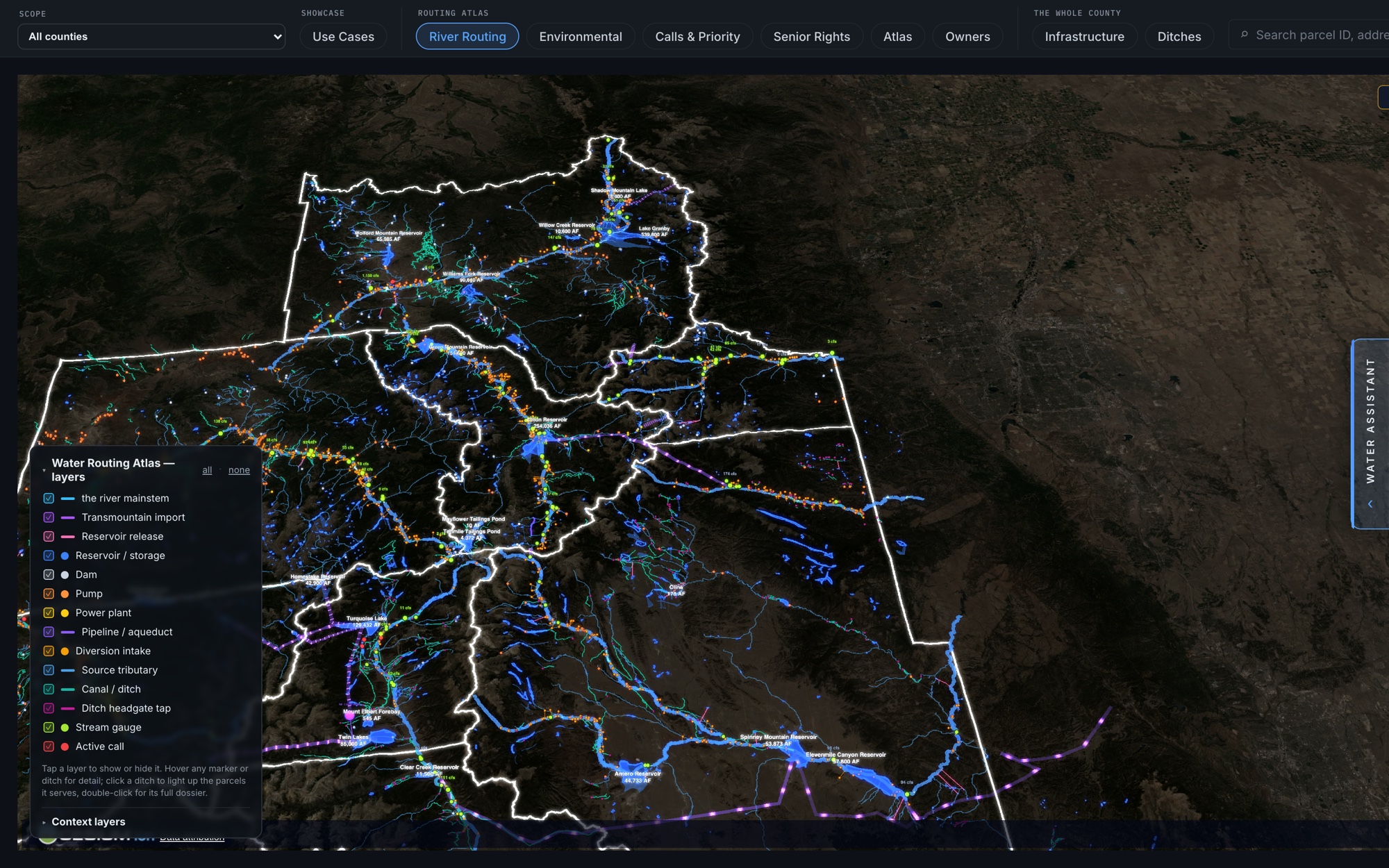
The whole network in one view — transmountain imports, reservoirs, diversions, canals, and stream gauges drawn on the real terrain, with active priority calls lit in red. Every line is a real structure you can open to its decree.
Every decreed right carries its own diligence
Select a water right and Ark-GARI opens its dossier — decree and priority, usability and risk, calls, and substitute supply. Because the right is tied to its parcel and owner, that dossier also carries the diligence that decides whether you can rely on it. Every facet is the water's — not a generic parcel report.
Answers you can prove, not guesswork
The regulatory systems your work depends on are real systems that connect in specific ways. We build exact digital replicas of them, anchored in the source — so you always know where you stand.
Anchored in the source.
Every right traces to the DWR diversion record and the water-court decree behind it. We read the frameworks so you don't have to — and show you the source, not a summary of it.
Every answer has a paper trail.
When a client, an engineer, or a judge asks why, you have a direct citation — not a chatbot's best guess. DivideGraph never tells you something it can't prove.
See the exposure before it finds you.
Curtailment, abandonment, inadequate supply — the risks that decide a deal or a dry year. Ark-GARI surfaces them from the same record the state administers from.
One record, many questions.
Owners, parcels, structures, decrees, calls, and gauges connect in one model — so a question about a headgate can reach the decree, and a question about a parcel can reach the ground.
The same method, applied to bank regulation
FSI GARI
NIST, FFIEC, and DORA frameworks modeled as a graph, so an examiner’s question gets answered with a citation and a complete audit trail — not a guess. Built for community banks under rising compliance pressure, including the new questions about AI governance.